

models
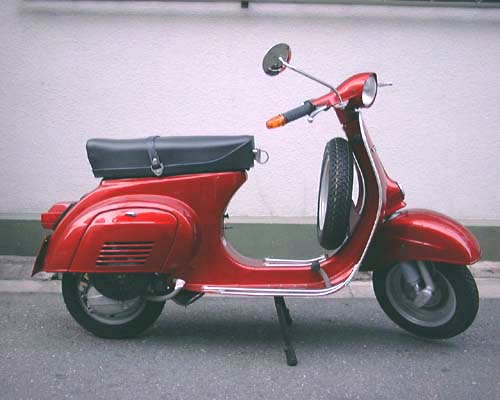
1963 Vespa 50 S, 1985 Vespa 50 S estero and 1985-1999 50 S Vintage (V5SA1T)
Introduced in 1963 the 50 S (Sport) was an export model, which improved upon the specification of the 50 N in several ways. Firstly it gained a 4 speed gearbox, plus from somewhere an extra 1bhp was found to give it 2.5bhp and a top speed of 60km/h. A dual seat was standard as were 10 inch wheels. A cast aluminum tail light, finished in body colour, replaced the small plastic light of the 50 N and 50 L. Because of its extra power it fell foul of Italian legislation of the time; thus it was an export model, with most going to Germany.
In Japan demand for vintage Vespa scooters was so high that it was profitable for Piaggio to restart production of classic smallframes from 1985 until 1999. Production finally stopped only upon the retirement of the specialists building them. In a special sector of the Pontadera factory a few thousand brand new "Vintage" smallframes (50s, 100 and 125 ET3) were built exclusively for Narikawa of Japan, who were the sole Japanese Vespa distributor. They remained on sale until 2000. Then official designation was 50 S Estero (export) though in Japan they were called the Vintage Series.
Vespa 50 S Vintage
The sole Japanese distributor was a company called Narikawa. These guides were produced in Japanese by Motorino Del Vento, a Japanese dealer. I originally copied them to this site in order to translate them because we only had Babelfish 20 years ago, and it didn't do popups. I've got rid of the popups now anyway. We all have bigger screens and more data these days. The original page is here
Purchase guide
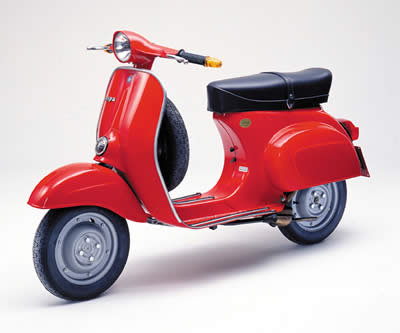
The smallest displacement scooter of the vintage series.
Twist grip 4 speed gearbox, fuel-mixture oil supply and kick start.
Popularity is high within the Vintage series because it qualifies as a moped. The top speed is approximately 65KM/H, but it's difficult to describe the acceleration as sharp. To ride briskly, considerable technique is needed. However, if you ride it slowly, it is still quite fun.
It is true to say of all the Vintage series that unless maintenance of the cables is properly done, it will become rather difficult to ride. The clutch cable is especially heavy and easy to break if servicing is not performed on it while the scooter is new.
However, if maintenance it is done thoroughly, a domestic [Japanese] scooter cannot hold a candle to it in terms of durability.
It is often considered the Vespa is expensive, but while you could possibly make this in Japan, in this material, it would not be possible at this price. Moreover, I think it would be worth that much just for the design.
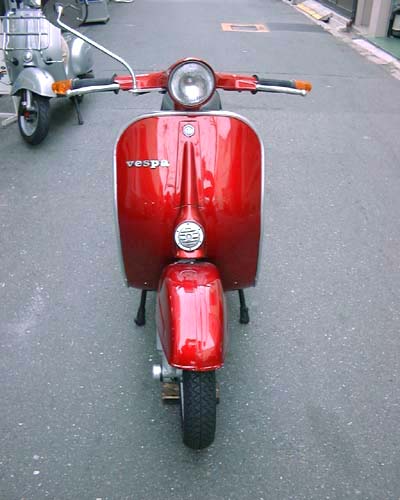
Front view
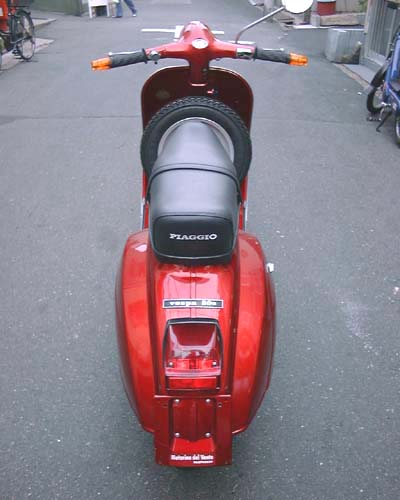
Rear view
Left-hand side
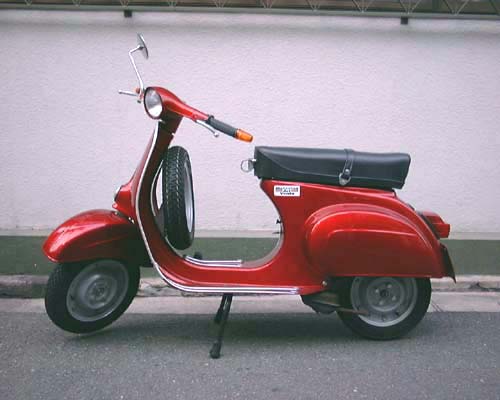
The famous single-sided suspension with interchangeable front and rear wheels.
Right-hand side
Headlight
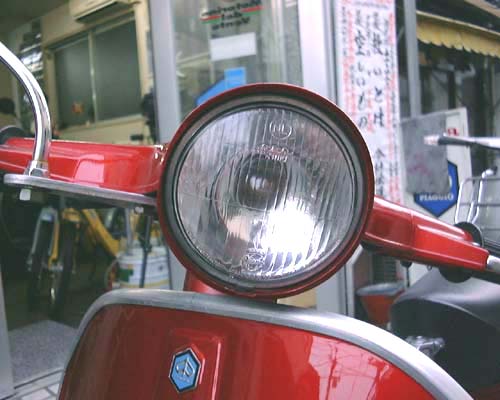
High-Low switchable beam. The 6V25W bulb is dim. Use of a domestic [Japanese] bulb isn't possible because of the special shape of the bulb socket.
Gearchange
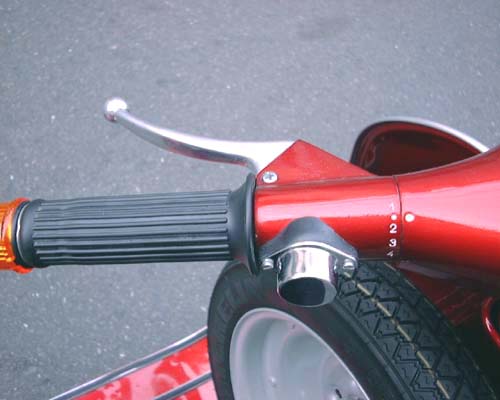
The twist-grip gearchange is one of the characteristics of the Vespa. Unlike the throttle, instead of just the grip, the whole clutch lever assembly turns.
The place where the number and the dot line up is the present gear, so for example, when you're in 4th gear, the clutch lever will be pointing quite far downwards.
Throttle
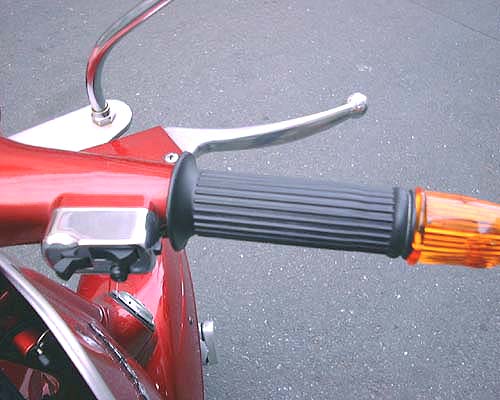
The throttle of the Vintage Series does not return automatically when you release your grip. It takes a bit of time to get used to it, but once you have, it is much easier to ride for long periods of time.
Speedometer
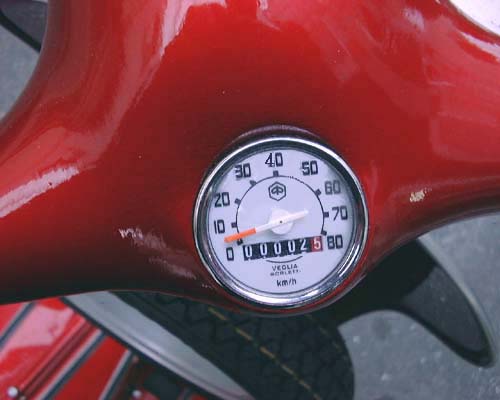
The speedometer is made by Veglia. Because it is shared with the 100 it has graduations to the 80 KM/H. In daytime it is easy to see, but because there's no illumnination you cannot see it at night. There is an odometer, but no trip meter.
Foot brake
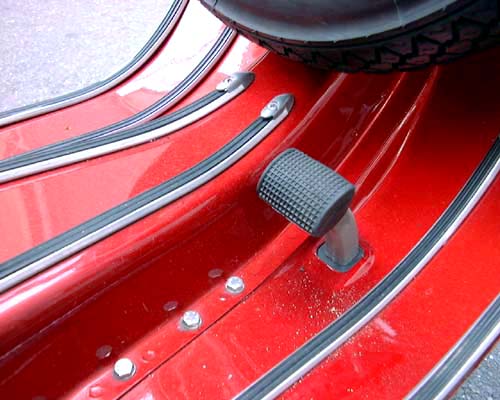
The vintage rear brake is operated with your foot like a motorcycle. It is easier to use if you place your heel on the center tunnel and press it down, rather than placing your foot flat on the floor.
Spare tyre
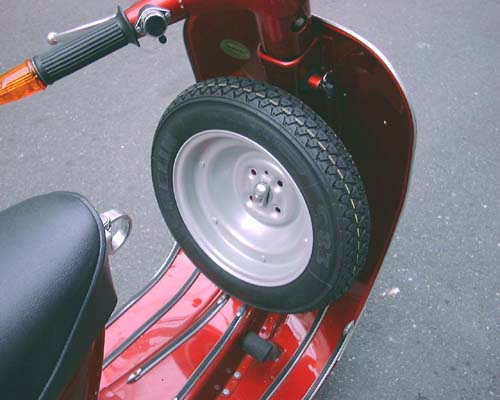
This spare tire is unique to Vespa. The front and rear wheels and the spare tire are the same size, so they can be rotated. Because it is a single-arm suspension, anyone who can change tires on a car can do it.
Steering lock
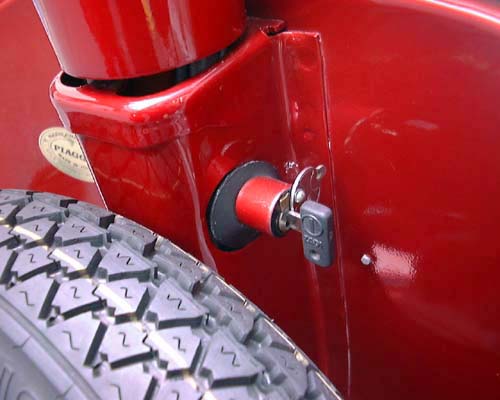
There is no ignition key on the 50S, and the only security is the steering lock. However, do not worry, as this lock is not easily broken by the kicking it or ramming in scissors.
Use a cable lock or similar to prevent it being lifted and stacked in a truck.
Seat
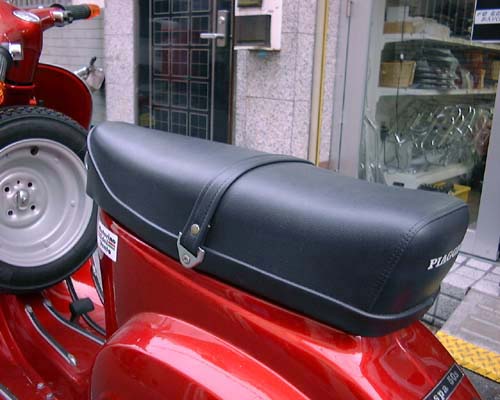
It has a double seat, which is a common part for models up to the 125. The springs are stretched over an iron frame, then urethane is applied and the seat cover is placed over it. It is a very elaborate seat. If it tears, there are parts for just the seat cover. The hook on the front of the seat is a bag holder and does not have a lock. A type with a lock is available as an option.
Tool box
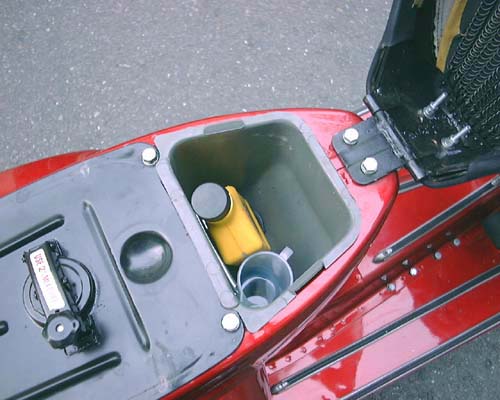
You can fit your oil and measuring cup et cetera, as well as the toolkit.
Carburettor
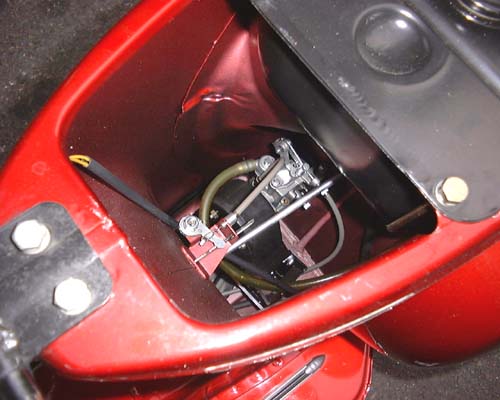
Carburetor can be found below the tank by removing the tool box. It is a 16mm Dell'Orto. When new they have a tendency to stick or clog, so an overhaul is always performed before delivering a new scooter.
Exhaust Silencer
A common part with the 100. The capacity is abnormally small by current standards. Naturally, the volume will be louder than that of domestic [Japanese] scooters. This type allows the tyre to be replaced without removing the exhaust.
Engine
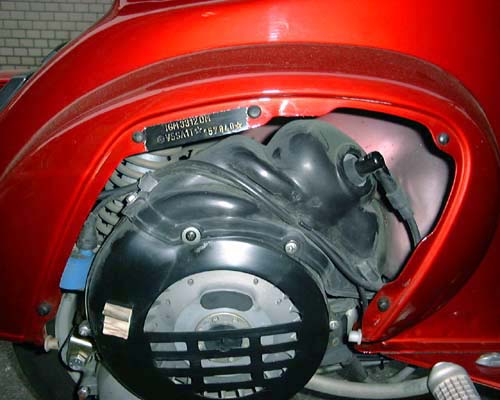
Forced air-cooled, point ignition engine. The flywheel/fan is heavy, so the engine response is slow, but it is tenacious. Because it is a point ignition system, regular maintenance is necessary, but it is easy to deal with problems.
Front End
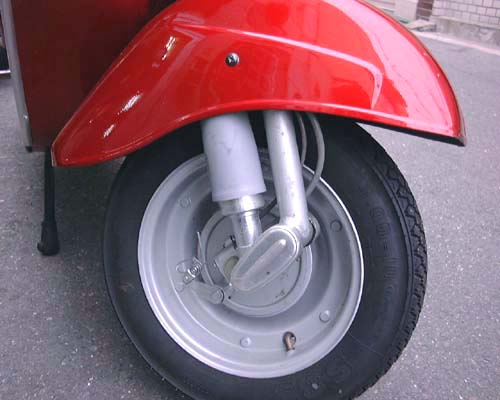
The front end, designed based on airplane wheels, is quite unusual for a motorcycle. Maintenance is also easy. However, the drum brakes are not very precise, so they are not very effective. Compared to previous models, the latest ones work better. The front suspension is not very good, so if you stiffen it up, it will be quite stable.
Kick starter
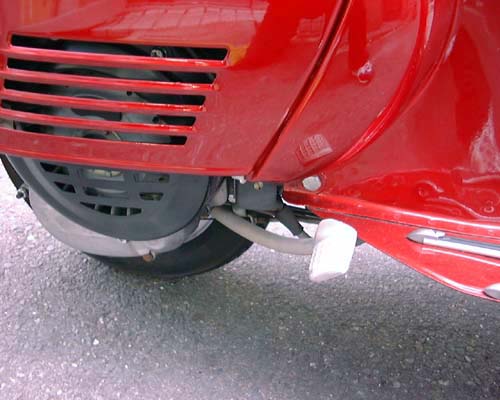
No starter motor is fitted of course because there is no battery. Starting the engine is via a kick starter. You cannot kick while holding in the clutch.
Inside the engine
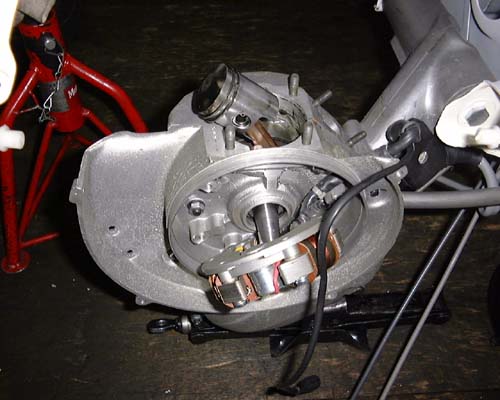
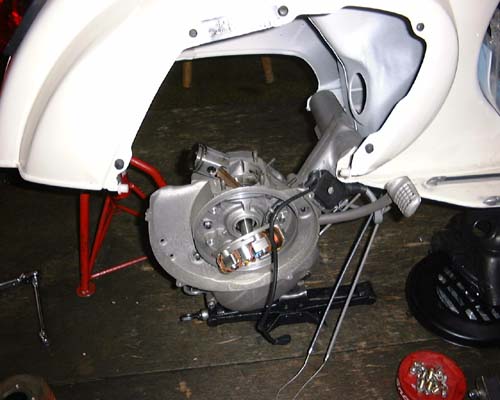
The engines are similar but the 50cc models have a small piston. This photo is of pre-delivery servicing.
Direction indicator
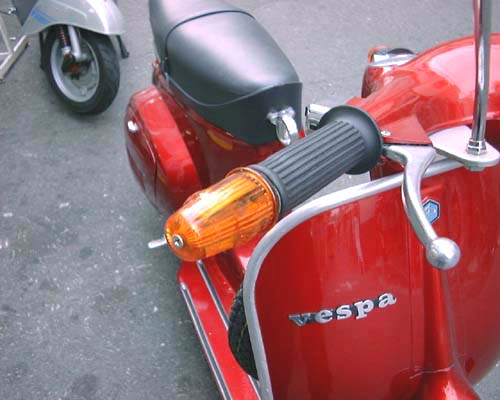
This is considered a Vespa feature, but in Italy, vintage bikes don't have turn signals, so this was actually added as a last resort. Originally, it had German-made HELLA indicators, but later models have Italian-made TRIOM indicators. If you buy the parts, they are still made by HELLA.
Horn
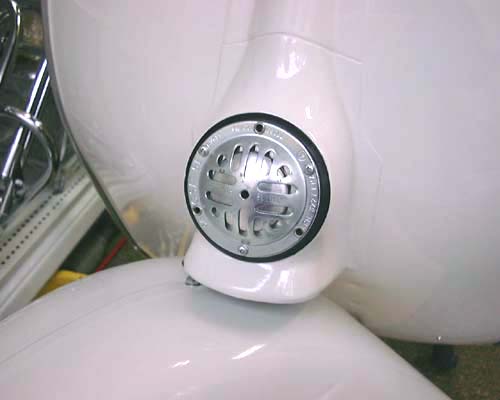
The Vintage Series has a unique sound. Because it has no battery, the sound is generated at a frequency that corresponds to the engine speed. It's charming, so there should not be any road rage caused by honking the horn.
Specification
- Type designation
- V5SA1T
- Top speed
- 60 KM/H
- Engine
- 49.77cc bore 38.4mm stroke 43mm two-stroke rotary valve
- Starting system
- Kick starter
- Ignition system
- Flywheel magnetic 6v/40W
- Lubricating system
- Mixture
- Fuel consumption
- 55km/l (CUNA)
- Tank capacity
- 5.6l
- Gearbox
- 4 speed twist grip
- Tyre size
- 3.00x10"
- Length / Width / Height
- 1,655mm / 670mm / 1,015mm
- Wheelbase
- 1,180mm
- Weight
- 73kg
- Price
- ¥325,000